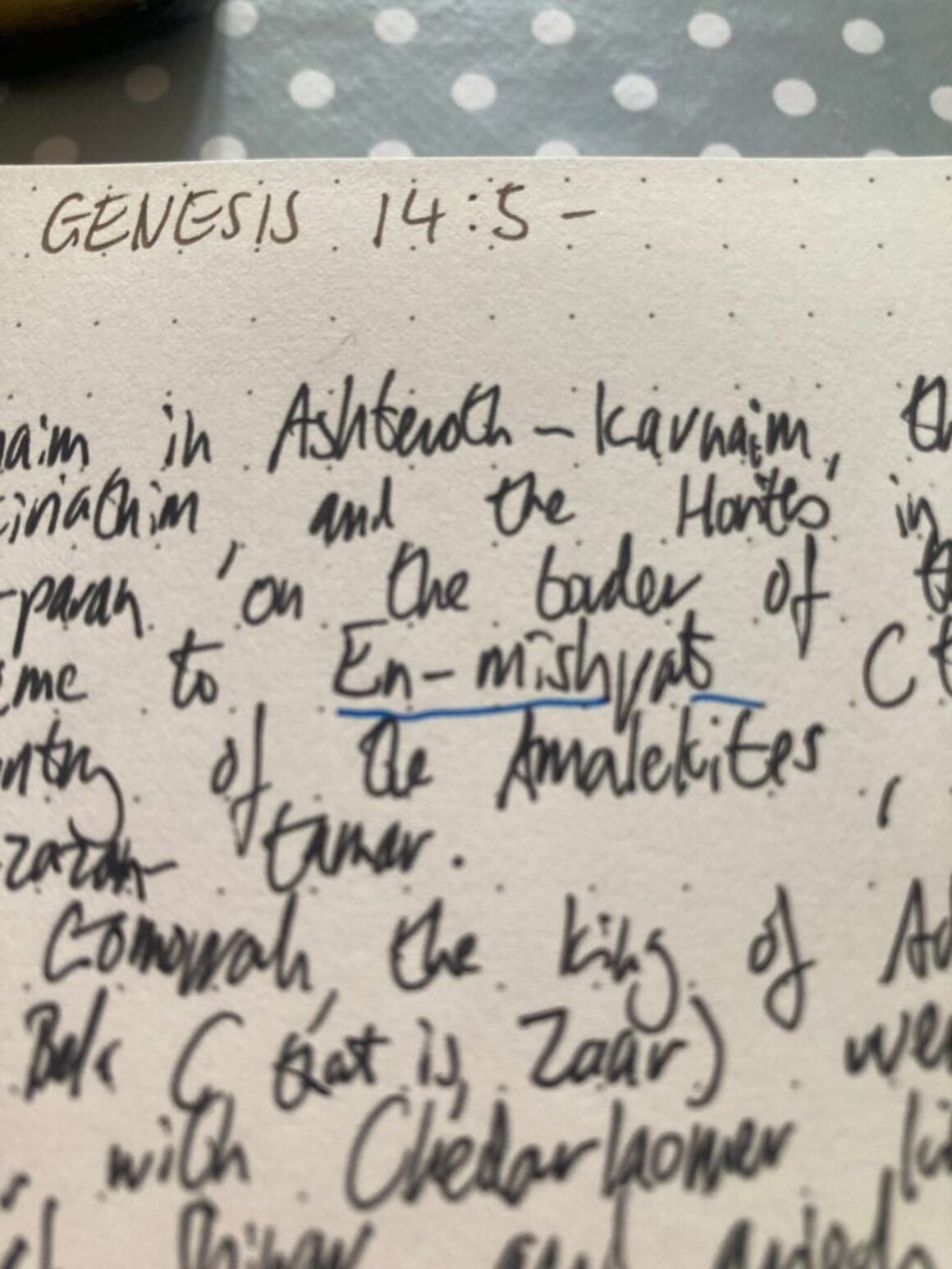
Hang on. I know that word.
Gareth Writes: There are bits of the Bible that are easier to read than others.
Genesis 14 probably isn’t going to make many people’s list of favourite passages.
It begins with kings with unfamiliar names, fighting other kings with unfamiliar names, in places with unfamiliar names, inhabited by peoples with unfamiliar names.
Chedorlaomer. Amraphel. Arioch. Tidal.
Rephaim. Zuzim. Emim. Horites.
Ashtaroth-karnaim. Shaveh-kiriathaim.
You get the idea.
It’s the sort of passage my eyes can move across considerably faster than my brain does.
But my hand can’t.
I’m writing out the Bible, word by word. Which means no skimming, no skipping bits.
So this week I found myself writing:
Then they turned back and came to En-mishpat (that is, Kadesh)…
Mishpat.
I know that word.
Or at least, I thought I did.
So I checked (and I did). I checked Tim Keller’s book “generous justice” that I’ve read a few times and was sure it was in there. Others might use a Bible dictionary, or google, or even AI.
Mishpat is the Hebrew word for judgment or justice. En-mishpat means something like “spring of judgment, well of justice.”
Interesting.
And then there was the little explanation in brackets:
“that is, Kadesh.”
Hang on.
I know that place too.
Except I know it from later. From Israel’s wilderness story. What is Kadesh doing here, before there’s even been an Exodus?
And the name itself belongs to the Hebrew family of words concerned with holiness — being holy, being set apart.
So I put a little blue line under En-mishpat and carried on writing.
But now I was wondering.
Justice. Holiness.
Bible words. But here they are as place names.
What are they doing here?
Kings and judgment
The context made it more interesting.
These foreign kings are sweeping through the land, defeating one people after another. They come to the Spring of Judgment — the place later known as Kadesh — and defeat the people living there too.
And that started connecting with something much bigger in the Bible.
God can use foreign kings to bring judgment.
Later in the biblical story, he’ll do it with Assyria. He’ll do it with Babylon. Nations which don’t worship him, and whose motives are hardly godly, can nevertheless become instruments through which his judgment comes.
That doesn’t make those nations righteous. God judges them too.
But it reminded me that biblical judgment isn’t simply another word for punishment.
Mishpat is justice. Judgment. Things being judged rightly. People getting what they are due. And, in the bigger biblical story, things being set as they were always supposed to be.
Punishment can be part of justice, of course. But justice is bigger than punishment.
And here was that word, hiding inside a place-name I’d probably have sailed straight past if I hadn’t been forced to write every letter of it.
Then I stopped again
A few lines later I wrote:
Then one who had escaped came and told Abram the Hebrew…
And stopped again.
Hebrew.
Have I written that word before?
I flicked back through what I’d written.
No.
This is the first time the Bible calls someone a Hebrew.
So another blue note went at the bottom of the page:
First time I’ve written this word — why here, why now?
I don’t have an answer yet. That’s OK. I may not get one. And if I do, I may not blog about it.
Abram has been around for a while by Genesis 14. We’ve seen his call, his journey into Canaan, his disastrous excursion into Egypt and his separation from Lot.
But here, surrounded by this catalogue of nations, peoples, territories and kings, he is suddenly Abram the Hebrew.
Why here?
Why now?
That’s a question I hadn’t thought to ask before.
A different kind of king
And then the chapter keeps going.
Abram goes to war. He defeats the kings. He rescues Lot and brings back the people and possessions that have been taken.
Which means Abram now finds himself doing rather well in this world of kings.
But he doesn’t behave like them.
The chapter began with kings conquering, taking and accumulating.
Abram wins — and refuses to take.
The king of Sodom offers him the goods and Abram says no. He won’t allow the king of Sodom ever to say “I have made Abram rich.”
God has promised to make Abram’s name great. Abram doesn’t need to seize greatness for himself.
And between Abram’s victory and his refusal stands another king.
Melchizedek, King of Salem, Priest of God Most High.
He comes not taking — but bringing. Bringing bread and wine.
And he blesses.
Like God.
Who, though “Possessor of heaven and earth,” is no grasping king.
He comes bringing. Giving.
Bread and wine. Body and blood.
And He blesses.
Oh, how He blesses!
What is writing doing to my reading?
Perhaps that’s the question underneath all of this.
I’m not just getting through the words slowly enough to notice more of them. I’m spending long enough among them for one thing to bump into another.
Mishpat.
I’ve heard that before.
Kadesh.
I know that place.
Abram the Hebrew.
Wait — have I written that before?
Kings who take.
A king who brings.
Bread and wine.
And suddenly I’m not simply copying Genesis 14 anymore. I’m seeing threads running out of it into the rest of the story.
Some of those threads need pulling carefully. Not every similarity is an intended connection, and slowing down doesn’t make every thought I have correct.
Genesis doesn’t, for example, tell me that Chedorlaomer and his buddies are instruments of God’s judgment. And they’re certainly not bringing judgment on God’s people — who at this point number rather fewer than the promised grains of sand or stars in the sky.
That’s OK. Noticing a connection doesn’t mean I’ve understood it yet.
But I wouldn’t even have the questions if I hadn’t stopped long enough to notice.
A week or so ago, Genesis 14 was exactly the sort of chapter I could have read and thought I’d read.
My eyes would have passed over En-mishpat as just another place name.
I wouldn’t have wondered why Kadesh had popped up here, before the Exodus.
I wouldn’t have noticed that this was the first time I’d written Hebrew.
I might have hurried through the difficult names to get to the interesting bit about Melchizedek.
Instead, I had to write them — every king, people, place.
And somewhere in that restful rhythm of Bible, page, Bible, page — eyes moving back and forth, hand occupied — my brain had enough time to say:
Hang on. I know that word.
Then:
Hang on. I know that place.
Then:
Have I written that before?
And eventually:
Where does this go?
I started this project because I wanted to read the Bible more slowly.
I’m discovering that writing doesn’t just slow my reading down.
It’s changing what I notice when I read.
And, therefore, what I wonder about.
And, in time, I trust, who I’m becoming.
First posted on stillreadingthebible.substack.com on 10/09/2026